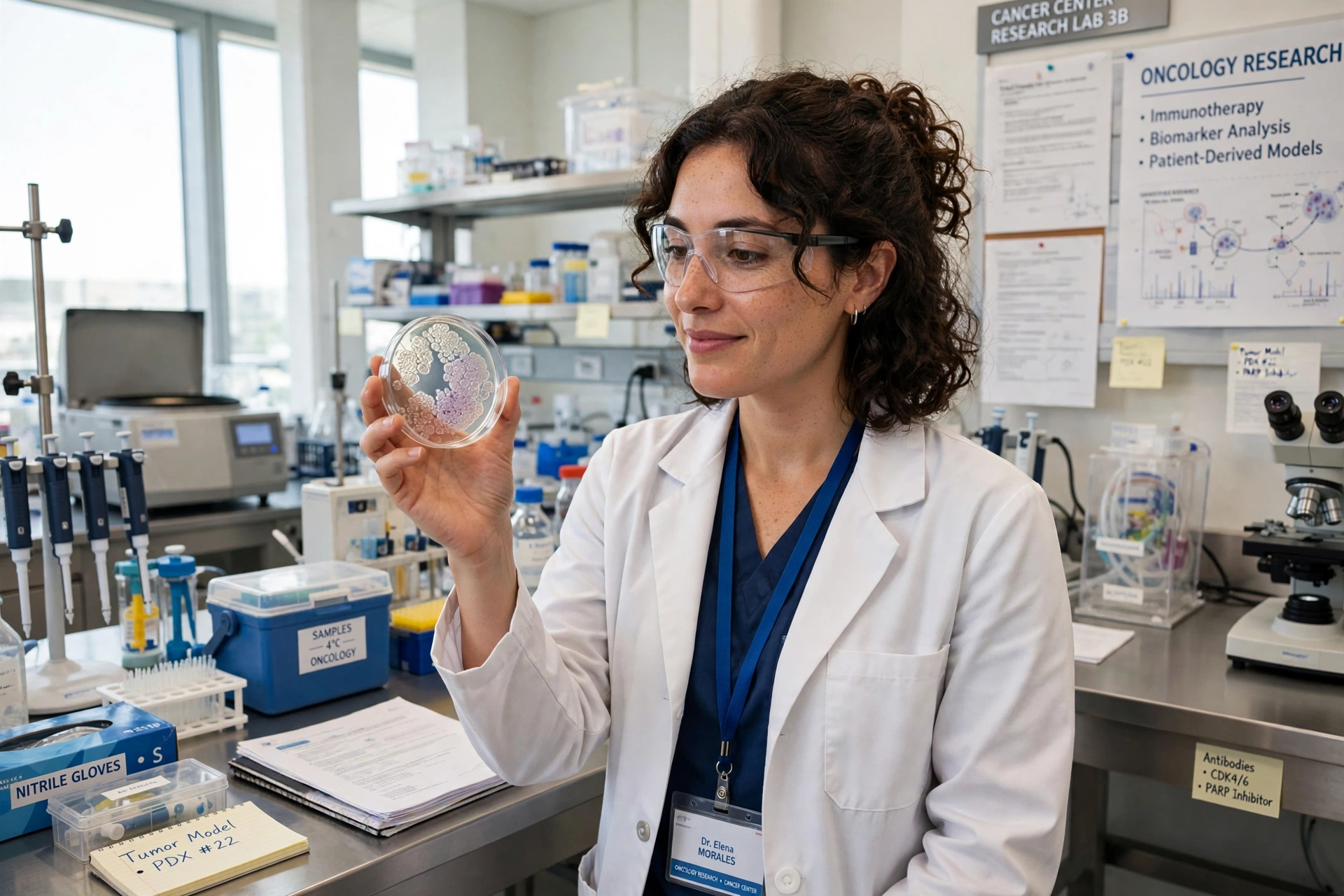
A vaccine is usually something given to healthy people to prevent disease. A different idea is now being tested carefully in cancer care: a vaccine built for one patient only, using information taken from that person’s own tumour. In a phase 1 trial published in Nature Medicine, researchers tested such a vaccine, called NeoVax, together with the immunotherapy drug nivolumab in people with platinum-sensitive recurrent ovarian cancer.
It is important to read this news at the right volume. This was an early feasibility and safety study, not a demonstration that the treatment cures ovarian cancer or extends life. In the same spirit as our recent reporting on a stalled policy change and what it actually means, the useful question is narrow: what did the researchers set out to test, and what did they actually show?
What NeoVax is, in plain terms
As a tumour grows, its cells accumulate genetic mutations. Some of those mutations change the proteins the cells produce, creating fragments called neoantigens that look unfamiliar to the immune system. A personalised neoantigen vaccine starts by sequencing a patient’s tumour, identifying promising neoantigens, and manufacturing a vaccine designed to present those targets to the patient’s immune cells. Background explainers from the National Cancer Institute describe neoantigens as a central reason researchers hope such vaccines can train a response aimed at the tumour rather than at healthy tissue.
NeoVax was combined with nivolumab, a PD-1 immune checkpoint inhibitor. Checkpoint inhibitors work by releasing a brake on immune cells, and the reasoning behind the pairing is straightforward to state, if difficult to prove: the vaccine tries to point T cells toward tumour-specific targets, while nivolumab tries to stop those T cells being switched off too readily. Whether that pairing produces a clinical benefit is a question for larger, later trials, not for this one.
What a phase 1 trial can and cannot show
Phase 1 studies are the first careful step in people. Their main jobs are to check that a treatment can be delivered as planned, to watch closely for side effects, and to gather early biological signals. The ovarian cancer trial, reported in Nature Medicine, followed that pattern. The researchers reported that personalised vaccines could be manufactured for patients and administered alongside nivolumab, that safety was acceptable in this small group, and that immune responses, including T-cell responses directed at vaccine targets, were observed.
Each of those findings matters, and each has a limit. Manufacturing success matters because a treatment that takes too long, or fails too often in production, cannot help patients whose cancer is progressing. Acceptable safety in a small group is reassuring but cannot rule out rarer harms. An immune response shows the biological idea is alive, yet a measurable T-cell response is not the same thing as a tumour shrinking, symptoms easing, or survival improving. Keeping those distinctions clear is not pessimism; it is how early science should be reported.
Why ovarian cancer is a difficult test case
Ovarian cancer is frequently diagnosed at an advanced stage and often returns after initial treatment, even when it first responds to platinum-based chemotherapy. The patients in this study had platinum-sensitive recurrent disease, meaning their cancer had come back but had previously responded to platinum treatment for a period. That is a group with real need for new options, and also a group in which careful interpretation matters, because outcomes vary widely between individuals.
Personalised vaccines face practical hurdles in this setting. Tumour tissue must be obtained and sequenced, targets selected, and a bespoke product manufactured and quality-checked, all while the patient may need other treatment. A feasibility result therefore carries genuine weight for researchers planning the next step, even though it tells patients very little yet about whether the approach will help them personally.
What should happen next
The normal path from here is a larger trial, ideally one that compares patients who receive the vaccine combination with a suitable control group, and that measures clinical outcomes such as response, duration of control and survival, alongside safety. Only that kind of study can begin to separate the effect of the vaccine from the effect of nivolumab alone, from patient selection, and from chance. Researchers will also need to show that manufacturing can be made faster, more reliable and more affordable if the approach is ever to move beyond specialist centres.
For now, the calm summary is this: NeoVax could be made from each patient’s own tumour mutations and given with nivolumab to people with recurrent ovarian cancer in a small phase 1 study; safety was acceptable and T-cell responses were seen. That is a meaningful early step for a demanding idea, and it is also all that this trial claims. Larger studies will decide whether the promise becomes a treatment.